WELCOME TO THIS GREAT AND EXCITING EDUCATIONAL BLOG

Welcome to my TEAS Exam Prep blog. I hope it will help you prepare very well for the pre-nursing entrance exam, popularly known as the TEAS exam. This is one of the entrance exams required by some schools for those who want to pursue careers in the nursing field in the USA. I will attempt to break down the review materials into manageable parts so that you can systematically and efficiently prepare for the test with less stress. I will guide you to prepare for the entire content of the test. Hopefully, you will be able to pass after going through these series.


Best of luck!


To support this blog and my effort to make more quality free educational videos you can make a donation by clicking on the link below. Together, we can change somebody's life one person at a time around the globe.
Become a Patron!

Monday, April 28, 2014

CHEMICAL BONDS

Basic concept on chemical bonds
1. Ionic bond: The bond formed when one atom looses electrons and the other accepts  
      them. It is formed when a metal bonds to a non-metal, example: NaCl
Original electronic configuration : Na  2:8:1                      Cl    2:8:7

Sodium loses one electron from its outermost shell (valence shell)  to become   Na+ 2:8                   and  chlorine gains this electron to become Cl-   2:8:8   
 Hence  Na+Cl-    -----------> NaCl

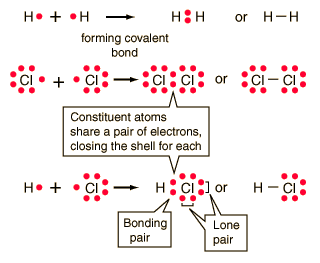
2. Covalent bond: This is the bond formed through the sharing of electrons. It is formed
    when non-metal bond to each other. Examples: H2, Cl2, HCl
Water is neither purely ionic nor purely covalent because the electrons are not shared equally. The more electronegative element, oxygen, tends to pull the shared electrons from the less electronegative (electropositive), hydrogen atom. One end, or pole, of the molecule has a partial positive charge (+), and the other end has a partial negative charge (-).Water is best described as a polar compound.

As a rule, when the difference between the electronegativities of two elements is less than 1.2, we assume that the bond between atoms of these elements is covalent. When the difference is larger than 1.8, the bond is assumed to be ionic. Compounds for which the electronegativity difference is between about 1.2 and 1.8 are best described as polar, or polar covalent.

Hydrogen bonding: When hydrogen atoms are joined in a polar covalent bond with a small atom of high electronegativity such as O, F or N, the partial positive charge on the hydrogen is highly concentrated because of its small size. If the hydrogen is close to another oxygen, fluorine or nitrogen in another molecule, then there is a force of attraction termed a dipole-dipole interaction. This attraction is known as hydrogen bonding.

Hydrogen bonding has a very important effect on the properties of water and ice. Hydrogen bonding is also very important in proteins and nucleic acids and therefore in life processes. 

THE REFLEX ARC

When a person steps on a sharp object, the response is immediate. It does not initially involve the brain. This involves the reflex arc which occurs in the spinal cord. The reflex arc consists of the sensory neuron (also called the afferent neuron), which transmits the stimuli of pain to the spinal cord. Within the spinal cord, it relays with the interneuron which decodes the message and sends the response to the muscles of the limbs via the motor neuron (also called efferent neuron) to bring about an action.

Diagram showing the reflex arc.

Friday, April 25, 2014

BASICS OF ELECTRICITY

There are two types of electrical circuit arrangements.
1. Parallel circuits: There is an alternate path to the flow of the current if other paths are blocked.

Note on diagram below: The symbol "R" represents any form of resistance such as bulb resistors, etc. The symbol "E" represents a cell such as battery, a current generator.

2. Series circuit: There is only one path for the current to flow. When this path is blocked, there will be no flow of current.
 
 Animation in a series circuit.

UNITS OF ELECTRICAL QUANTITIES

VariableSymbolUnitSymbol
VoltageVVoltsV
CurrentIAmpereA
Resistance

Power
R

P
Ohm

Watt
Ω

W

Formulas you should know:
1. Voltage = Current x Resistance
2. Power = Voltage x Current

You should be able to use these formulas in calculations.

MAGNETISM AND ELECTROMAGNETS

Magnetism

There is a magnetic field around a magnet. This is a mathematical representation of the interaction between the magnetic material and electrical current. It is represented by magnetic field lines which moves out of the north pole into the south pole.

Diagram of magnetic field lines.

It is very important to note the direction of the arrows on the field lines.

Interaction between two magnets
1. North and South poles attract (opposite pole attract). Diagram of attractive forces.
2. North and north poles will repel; south and south poles will repel (Like poles repel).

Diagram of repulsive forces for north to north poles.

Diagram of repulsive forces for south to south poles.

Electromagnetism is the study that involves the use of electricity to create magnet and vice versa (that is, using a magnet to generate electricity).

What is a solenoid?

The solenoid is a long coil containing a large number of close turns of insulated copper wire. A magnetic field  is produced by the current carrying solenoid. The strength of magnetic field produced by a current carrying solenoid is directly proportional to the number of turns and the strength in the solenoid. It is also dependent on the nature of "core material" used in making the solenoid. When soft iron rods are used as cores, they produce the strongest magnetism. Solenoids are used for making electromagnets. 

What is an electromagnet? Diagram

When an electric current flows through a soft iron rod placed inside a solenoid, a temporary magnet is created. It acts as a magnet only so long as the current is flowing in the solenoid. This combination of a solenoid and a soft iron core is called an electromagnet. An electromagnet, therefore, consists of a long coil of insulated copper wire wound on a soft iron core.

Here are some uses of electromagnets:
1. Used in cranes to lift heavy metal.
2.  Used in electric bells
3. Used in radio speakers
4. Used in microphones
5.  Used in dynamos


Tuesday, April 22, 2014

STRUCTURE OF THE HUMAN BRAIN

The brain is very complex but we will discuss the basic concepts needed for the exam.

1. Cerebrum: This forms the bulk of the brain and it is responsible for the intellectual functions such as thinking, learning, motor skills, sensory functions, personality, etc.
2. Cerebellum: This is the center that helps with balancing of the body during various movements.
3. Medulla oblongata: This is the cardio-respiratory center. It controls the rate of the heart and also the rate of respiration. It is closely related to first cervical bone which has the protrusion called the dens. When the dens fractures during a whiplash injury, it can compress on the medulla and then the heart and respiratory system will fail to function.
4. Thalamus: This relays motor and sensory signals to the cerebral cortex. It regulates consciousness, sleep, and alertness. 
5. Hypothalamus: The hypothalamus is responsible for certain metabolic processes such as the synthesis and secretion of certain neurohormones (often called releasing hormones or hypothalamic hormones). It also plays a role in autonomic nervous system by controling body temperaturehunger, important aspects of parenting and attachment behaviors, thirst, fatigue, sleep, and circadian rhythms.
6. Pons: This acts as a relay station between the cerebrum and the cerebellum. It is also plays a role in sleep and dreaming.

THE STRUCTURE OF THE EAR

Click here to look at the Diagram of the human ear

There are three parts of the human ear. We will not deal with the fine details here. Just know the basic things.
1. Outer ear: This extends from the pinna (ear lobe) to the tympanic membrane/tympanum (ear drum). It has the auditory canal or meatus. This conducts sound to the middle ear.
2. Middle ear: The middle ear house the three bony structure called incus (anvil), malleus (hammer), and stapes (stirrup). They vibrate to transmit the sound waves to the inner ear.
3. Inner ear: The houses the cochlear, semi-circular canals, and the vestibule. There are three semi-circular canals arranged at right angles to each other (superior, lateral, and posterior semi-circular canals)

Important to note: The cochlear is the organ for hearing. The semi-circular canals are the organ for balancing.

Think about what will happen when the cochlear or semi-circular canal is damage.

THE STRUCTURE OF THE EYE

Today, we will discuss the basic structure of the human eye.

          Lens: For focusing of objects onto the retina.
          Iris: Controls the amount of light entering the eye by changing the size of the pupil.
          Pupil: This is the aperture (hole) bounded by the iris.
          Retina: The back of the eye where the image is formed. Contains the light sensitive structures rods and cones.
          Rods: Needed for night vision since they are very sensitive to light. Helps to distinguish between black and white objects.
          Cones: Needed for day time vision and for distinguishing between colors.
          Optic nerve: Transmits the image from the retina to the brain.


  •  The lens divides the eye into anterior and posterior chambers. The anterior chamber contains the fluid called aqueous humor and the posterior chamber contains the gel-like substance called the vitreous body.
  • The ciliary muscles control the thickness of the lens. That is, it stretches the lens.
  • The Canals of Schlemm drain the aqueous humor.